Princess Book Card 3D SVG: An Embroidery Review
As a designer who constantly bridges the gap between digital cutting files and needle-and-thread execution, I approach every new asset with a specific question: will this actually translate to fabric? When I first opened the Princess Book Card 3D SVG, my immediate thought was not about paper crafting, but about its potential as a structural blueprint for a mixed-media embroidery project. While this product is categorized under Paper Sculptures and optimized for Silhouette Studio and Cricut Design Space, experienced makers know that clean vector lines are the foundation of exceptional digitizing. I evaluated this design specifically to see if it could serve as a guide for creating a high-value, personalized gift or a boutique product that stands out in a saturated market.
Translating Vector Lines to Stitch Paths
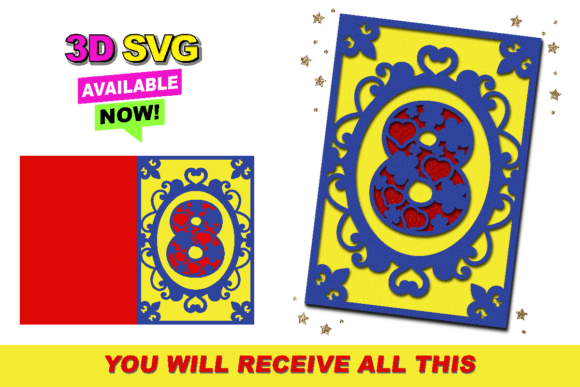
The visual personality of the Princess Book Card 3D SVG is undeniably whimsical yet structured. It possesses the intricate layering typical of paper art, which presents both an opportunity and a challenge for machine embroidery design. In a real-life scenario, I envisioned adapting this file to create a custom embroidered tote bag for a children’s book launch or a specialized baby embroidery keepsake. The "book card" concept implies depth and dimension, suggesting that a flat fill stitch would fail to capture the essence of the original design.
Instead, this SVG serves as an excellent template for an applique design. The distinct layers meant for paper assembly can be reimagined as fabric layers. However, because this is a 3D SVG intended for cutting machines, you must verify the line integrity before importing it into your embroidery software. Clean vectors mean smoother running stitches and more precise satin stitch borders. If the nodes are messy, your needle will hesitate, leading to jagged edges on your finished product. For those using this as a base for commercial embroidery, the clarity of these lines directly impacts production speed and thread breaks.
Real-World Application: The Custom Tote Bag Test
To truly judge the viability of the Princess Book Card 3D SVG, I mentally prototyped a project for an Etsy seller targeting the nursery decor niche. Imagine a canvas tote bag featuring this princess book motif, intended as a personalized gift for a new mother or a young reader. The design’s layout suggests a central focal point that requires careful hoop size selection. Because the original file is designed for paper folding, the aspect ratio might be taller or wider than standard embroidery hoops.
In this application, the design performs best when treated as a centerpiece rather than an all-over pattern. For sweatshirt embroidery or aprons, the intricate details of the "princess" elements need to be scaled appropriately. If you shrink this design down to fit a 4x4 hoop, the internal details meant for paper scoring will become indistinguishable mud when stitched. I recommend maintaining a minimum width where the smallest satin stitch column remains at least 1mm wide to ensure stitching clarity. This attention to scale is what separates a professional handmade product from a hobbyist attempt. Customers trust brands that understand how design assets interact with fabric texture.
Navigating Fabric Limitations and Stabilizer Choices
While the Princess Book Card 3D SVG offers beautiful aesthetics, it demands respect for material constraints. This design should be used carefully on stretchy fabrics like jersey knits or thin performance wear. The density required to replicate the 3D effect of the paper sculpture through thread can cause puckering on unstable grounds. If you are planning baby clothes or lightweight summer apparel, you must use a heavy-duty cut-away stabilizer and potentially a topping to prevent stitches from sinking into the weave.
Furthermore, consider the contrast. A princess-themed design often relies on pastel thread colors. On dark fabric, these hues can disappear unless you employ a white underlay or choose a lighter background fabric for the applique sections. I always advise testing the design on scrap fabric first, specifically using the exact stabilizer combination you plan for the final run. Check whether the stitch density creates a stiff patch; if the goal is a soft baby item, you may need to manually reduce the fill stitch density in your digitizing software to maintain drape and comfort. This step is non-negotiable for anyone selling finished products where tactile quality drives buyer engagement.
Commercial Viability for Makers and Sellers
For small business owners and creative entrepreneurs, the value of this digital embroidery file extends beyond a single project. The Princess Book Card 3D SVG has strong potential for holiday embroidery collections or birthday party merchandise. Its storybook aesthetic resonates with buyers looking for nostalgic, timeless items rather than trendy flash-in-the-pan graphics. However, professionalism dictates due diligence. Before listing any custom apparel or embroidered patch derived from this file, confirm the licensing terms included in the zipped folder. Ensure you have the right to sell physical items made from this digital asset.
From a marketing perspective, this design supports excellent printable mockup creation. Because the source is a crisp SVG, you can overlay realistic stitch textures in Photoshop or Canva to show clients exactly how the personalized gift will look before you ever thread a needle. This reduces waste and increases customer confidence. For craft business owners, offering this design as part of a bundled collection—perhaps pairing the paper version for scrapbookers with the adapted embroidery version for sewists—can diversify your income streams. Just remember to clearly label the files so customers understand which is for cutting and which is for stitching.
Essential Designer Notes for Success
Before you commit the Princess Book Card 3D SVG to your next embroidery project, keep these practical checkpoints in mind:
- Verify Compatibility: The product description notes this is easy to cut on Silhouette and Cricut. If you are converting this for embroidery, ensure your digitizing software imports SVGs cleanly without altering node placement.
- Test Contrast: Review thread colors against your chosen fabric in natural light. Pastels on white can lack definition; consider adding a darker outline or shadow stitch to make the 3D effect pop.
- Inspect Small Details: Zoom in to 200% in your embroidery software. Any element smaller than 2mm should be simplified or removed to prevent needle damage and thread nests.
- Stabilizer Strategy: Match your stabilizer weight to the stitch count. A dense 3D-style stitch-out requires more support than a standard logo.
- Licensing Check: Always read the included documentation regarding commercial use for both digital product sellers and those selling physical handmade goods.
- Mockup Validation: Create black and white mockups to test value contrast before committing to color. If the design reads well in grayscale, it will stitch beautifully.
Ultimately, the Princess Book Card 3D SVG is a versatile starting point for makers willing to bridge the digital and textile worlds. It requires technical adaptation, but the result—a dimensional, story-rich embroidered piece—offers significant value for personalized gifts and boutique branding. By treating this vector file as a structural guide rather than a simple trace-and-stitch template, you elevate your work from basic decoration to true textile artistry.